
SEMICONDUCTOR REVIEW THANK YOU FOR SUBSCRIBING
× 
Semi Conductor Review Weekly Brief
Be first to read the latest tech news, Industry Leader's Insights, and CIO interviews of medium and large enterprises exclusively from Semi Conductor Review
Semiconductor Review: Specials Magazine

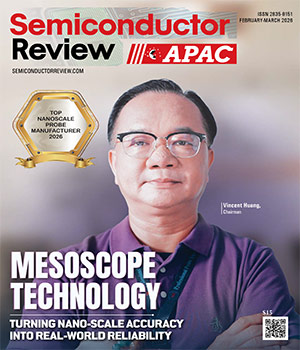
Mesoscope Technology
Turning Nano-Scale Accuracy Into Real-World Reliability
Turning Nano-Scale Accuracy into Real-World Reliability What defines Mesoscope Technology’s approach to nano-scale measurement reliability in semiconductor failure analysis environments? Mesoscope Technology builds nano-scale probing solutions for semiconductor failure analysis environments where measurement credibility is non-negotiable. Its metallic nano-probes are engineered specifically for SEM-based nano-probing and are deployed across advanced-node wafer fabs, third-party analytical laboratories, and OEM development workflows. In these settings, performance is not defined by what a probe can achieve once under ideal conditions, but by whether it behaves the same way across users, tools, and time in day-to-day production use. As device geometries push into the sub-3-nanometer regime, probing tolerances have narrowed to the point where tool variability directly compromises analysis outcomes. Stable electrical contact, controlled compliance, and repeatable mechanical behavior now matter more than peak specifications. Mesoscope’s engineering and manufacturing strategy is built around that reality, converting nano-scale access into dependable, production-grade measurement results. “At the nano scale, precision only matters if it is repeatable and usable in real labs,” says Patrick Harrington, vice president of sales. “Our customers are ultimately judging whether they can trust the data they collect across sessions and operators, not whether a probe meets an isolated specification.” Where Nano-Probing Stops Being a Commodity How does Mesoscope differentiate itself within the nano-probing market landscape? The nano-probing market is crowded with suppliers optimizing for sharpness, disposability, or short-term performance gains. Many probes are designed to deliver impressive initial results, but degrade unpredictably, forcing engineers to recalibrate data, question correlations, or treat probes as consumables. Mesoscope deliberately rejects these industry habits. Rather than producing disposable probes or one-off ultra-sharp tips, Mesoscope engineers probes as durable measurement instruments. The goal is not maximum sharpness at any cost, but controlled, repeatable contact behavior that holds up across long analysis sessions, multiple operators, and different SEM platforms. This philosophy directly addresses one of the most persistent problems in advanced-node failure analysis: data inconsistency caused by probe-induced variability. By designing probes that behave predictably over time, Mesoscope enables engineers to compare results across tools, sites, and process stages without introducing probing artifacts into otherwise controlled workflows. That discipline, rather than headline specifications alone, is what elevates Mesoscope from a capable supplier to a top-tier nano-scale probe manufacturer. Failure Analysis Conditions, Not Lab Ideals Advanced-node failure analysis increasingly involves probing partially developed structures, early silicon, or devices still undergoing process tuning. Contact windows are extremely limited, electron-beam voltages are kept low to avoid damage, and even minor mechanical disturbances can alter device behavior.
Semiconductor Packaging
In a global semiconductor environment characterized by increasingly tight design margins, growing complexity, and a constant need for agility, Hana Micron has established itself as one of the industry’s most trusted back-end partners. The company’s ability to translate customer expectations into high-precision reality has fueled its expansion from memory packaging into the fast-growing non-memory and high-performance computing (HPC) segments. How does Hana Micron convert fragmented customer expectations into scalable, high-precision back-end execution? Central to this success lies its “differentiated customized services”, a philosophy that goes beyond transactional projects. Hana Micron’s loyalty among global chipmakers stems from its co-engineered solutions model, built on trust, technological investment, and long-term collaboration. This model, integrated with the company’s commitment to quality and technical excellence, has transformed client relationships into enduring strategic partnerships. Clear project decision frameworks, regular technical exchange meetings, and transparent performance reviews govern these partnerships. Building Loyalty through Customized Partnerships What specific behaviors build long-term loyalty among memory customers during uncertain project cycles? In the memory segment, Hana Micron has cultivated enduring customer loyalty through reliable execution and shared success. The company supports customers in navigating uncertain new projects by committing early investments in tools, talent, and infrastructure, often ahead of competitors. This proactive stance has strengthened confidence among its long-standing memory clients, who trust Hana Micron not just to deliver, but to innovate alongside them. “Our edge comes from our willingness to make fast, proactive investments and our deep understanding of customers’ technical challenges. We don’t just supply, we solve and co-develop,” states Jung Eun, general manager..

Photonics

Test and Quality, Creston's Approach to Customer Loyalty
Ivan Farias, Senior Director, Production Operations, Crestron Electronics
Micro Electronics

Virtual Sensor Innovation Drives Higher Productivity
Russell Dover, General Manager, Service Product Line, Lam Research Corp. (LRCX: NASDAQ)
Sensor

Rapidly Moving Market of Semiconductor Packaging
Cherie Sasan, Head of Design and Development, Power Module Technology, Integrated Micro- Electronics, Philippines [PSE: IMI]
Semiconductor AI

A Paradigm Shift: Leveraging Artificial Intelligence and Machine Learning in Design Engineering
Matthew Yap, Associate Director, Microchip Technology Inc
Wafer

From Corporate Confusion to Career Fulfillment: 45 Years in Automotive
Dan Lovekamp, Director of Training, Auffenberg Dealer Group

IN MY OPINION
Sensor
Rapidly Moving Market of Semiconductor Packaging
Cherie Sasan, Head of Design and Development, Power Module Technology, Integrated Micro- Electronics, Philippines [PSE: IMI]

LAST WORD
Semiconductor Manufacturing
The Devolution & Revolution of Factory Operations
Christopher Downing, Senior Director of Operations/Manufacturing, MKS Instruments
IN FOCUS

Precision Manufacturing and the Rise of Nano Probes in APAC
Asia Pacific’s nano probe sector accelerates through material innovation, automation, and precision manufacturing, unlocking advanced applications across multiple industries.

Semiconductor Value Chain: Back-end Process Solutions Driving APAC's Chip Manufacturing Leadership
APAC’s semiconductor back-end process market expands through advanced packaging, automation, AI integration, regional manufacturing growth, and rising electronics demand.
EDITORIAL
How Disciplined Engineering Is Redefining Semiconductor Reliability
The semiconductor industry is operating in a phase where nanoscale accuracy and back-end process discipline are no longer supporting functions but central determinants of yield and reliability. As devices push into advanced nodes, the margin for variability has narrowed sharply, forcing manufacturers to reassess how probing, failure analysis, and data-driven process control are executed in real production environments. This edition of Semiconductor Review APAC examines how precision engineering and intelligent back-end solutions are converging to meet these demands.
Central to this edition is MESOSCOPE Technology, recognized as the Top Nano Scale Probe Manufacturer in Asia 2026. MESOSCOPE’s leadership is rooted in a clear engineering philosophy. Nano-scale precision is only meaningful when it is repeatable, durable, and trusted across users and tools. Designed exclusively for SEM-based failure analysis, its metallic nano-probes prioritize stable electrical contact, controlled compliance, and lot-to-lot consistency. By rejecting disposable probe economics in favor of productiongrade instruments, MESOSCOPE has significantly reduced probe-induced variability, enabling more reliable correlation between electrical and structural data in advanced-node analysis.
This edition also highlights contributors shaping the broader semiconductor back-end ecosystem. Russell Dover, general manager, service product Line at Lam Research, details how virtual sensors, equipment intelligence, and multivariate analytics are transforming chamber matching and fleet-level consistency. His perspective underscores how data-driven services are becoming essential for improving uptime, shortening troubleshooting cycles, and sustaining productivity in high-volume manufacturing.
Equally instructive is the systems-level viewpoint offered by Norm Balchunas, Senior Director at Honeywell Aerospace. While grounded in mission readiness, his insights on predictive analytics, connected monitoring, and data integrity closely parallel semiconductor priorities, where informed, real-time decision-making increasingly defines operational resilience.
Together, the perspectives in this issue reinforce a central takeaway. Leadership in advanced semiconductor manufacturing will belong to organizations that combine nanoscale engineering with disciplined execution and predictive insight. We invite readers to explore this edition and engage with the ideas shaping the future of back-end precision and process reliability.
This content is copyright protected
However, if you would like to share the information in this article, you may use the link below:
https://www.semiconductorreviewapac.com/edition/february-march-2026-34.html