
SEMICONDUCTOR REVIEW THANK YOU FOR SUBSCRIBING
× 
Semi Conductor Review Weekly Brief
Be first to read the latest tech news, Industry Leader's Insights, and CIO interviews of medium and large enterprises exclusively from Semi Conductor Review
Semiconductor Review: Specials Magazine
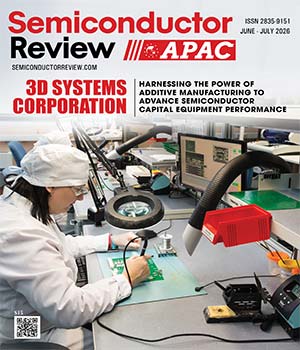
3D Systems Corporation
Harnessing the Power of Additive Manufacturing to Advance Semiconductor Capital Equipment Performance
As the speed and complexity of the smart devices and computers we use have continued to grow exponentially, so has the complexity of the microchips that enable them. This has placed increased pressure on semiconductor OEMs to deliver higher performance and reliability in their equipment. Although rising demand for microchips has made it necessary for semiconductor capital equipment manufacturers to expand production, building, shipping, installing, and commissioning new manufacturing lines capable of meeting modern precision requirements is technically challenging, time-consuming, and expensive. These lines are also often dependent on slow and inefficient supply chains, making them vulnerable to unanticipated issues that can extend product development cycles and result in lead times as long as six to nine months for additional tooling. It’s well known that the effectiveness of semiconductor manufacturing equipment can be impacted by disturbances at the nanometer scale and by temperature fluctuations in the millikelvin (mK) range. However, the constraints of traditional manufacturing techniques, such as casting or precision machining, make it difficult to design and produce functionally ideal parts with enough accuracy and durability to optimize performance. This can result in equipment with excess weight or volume that makes it prone to vibrations, leakage, pressure drops or other failures. Semiconductor capital equipment manufacturers incorporating metal additive manufacturing (AM) into their manufacturing processes can improve imaging performance, yield, quality, accuracy, productivity and reliability. Fig 1: Optimized showerhead monolithic design for even material deposition and increased reliability. While the potential for this technology is far-reaching, let’s focus on the advantages of using metal AM in three categories of applications: fluid flow optimization, thermal management and structural components optimization.
Semiconductor Manufacturing
Ruimeng Technology
Turning Analog Experience into Industrial Reliability
Xiong Xiang, Deputy Marketing Director
Founded in 2008, Ruimeng Technology is a fabless analog chip design company focused on motor driver and signal chain products. Its understanding of ‘analog’ is deeply embedded in its core capabilities, from product planning to volume production delivery. Depth in Analog Design It has a portfolio of more than 550-part numbers across five product lines, covering multiple stages in the signal chain. Customers can source compatible components from a single provider, reducing integration effort and the risk of mismatches across designs. This advantage comes from the company’s long-term focus on analog design. Concentrating on a single domain allows process knowledge, circuit experience and application understanding to build over time. This accumulated experience gradually strengthens the ability to co-design components, so they function not as isolated parts but as a system-level combination that works together organically. Industrial applications demand that level of coordination. Amplifiers, converters, interfaces and drivers are evaluated based on how they perform together under real operating conditions. Noise performance, resolution, voltage range and supply continuity determine whether systems meet performance requirements in the field. Ruimeng develops its products with these conditions in mind, ensuring that designs align with system behavior, enabling consistent performance in production environments. Precision Manufacturing for Demanding Environments Ruimeng’s analog expertise becomes most evident in precision-critical designs. In high-performance converters such as 24-bit Sigma-Delta ADCs, the design is fully optimized for actual operating conditions. Development follows defined constraints. Foundry process limits, layout discipline and simulation accuracy determine the performance ceiling in production.

Semiconductor Packaging

Recruitment Challenges in the HighTech Packaging World
August Miller, Director, R&D Design Center and Daniella Olson, Staff Engineer, Amkor Technology, Inc
Sensor

Rapidly Moving Market of Semiconductor Packaging
Cherie Sasan, Head of Design and Development, Power Module Technology, Integrated Micro- Electronics, Philippines [PSE: IMI]
Semiconductor Manufacturing
The Evolution of Insulated Gate Bipolar Transistors
Michele (Mike) Giulianini, Engineering Manager, Origin Energy
Electronic Components Distributor

Driving Customer-Centric Innovation in the Data Center Industrys
Jorge Quintana, Head of Sales North America, Anord Mardix
Semiconductor Manufacturing

The Floor is Farther than It Looks
Michael Burns, Director of Manufacturing and Quality, FreeWave Technologies
Testing and Quality Assurance

Driving Sustainable Energy Solutions for a Greener Future
Jason Colbenson, Senior Quality Assurance Specialist, Dairyland Power Cooperative
Semiconductor Packaging

Sustainability Has Entered Its Operational Era
Samuel Shiroff, Senior Director, Global Sustainability, EnerSys

IN MY OPINION
PCB Design
Building Strong Safety Cultures Across Complex Construction Projects
Curtis Corley, Director of Safety - South, AECOM Hunt

LAST WORD
Semiconductor Packaging
Building the Nation’s Power Systems
Timothy Sellers, Site Safety Director, Alberici Constructors
IN FOCUS

Emerging Trends in Fabless Chip Design: Adapting to the APAC Market Dynamics
APAC fabless chip design firms evolve through specialization, ecosystem collaboration, and resilient strategies, enabling innovation, adaptability, and sustained competitiveness within complex semiconductor markets.
APAC Semiconductor Surge: Advancements in RF and Analog Chip Design
APAC analog RF chip trends emphasize miniaturization, integration, advanced processes, and simulation-driven design for 5G, IoT, automotive, and communication applications.
EDITORIAL
Inside the New Operating Reality of Semiconductor Engineering
Semiconductor design is entering a more disciplined phase. Cost pressure, packaging complexity, manufacturing reliability and supply continuity are now shaping how companies build products and manage production across industrial, automotive and infrastructure markets. In this edition of Semiconductor Review APAC, the focus stays close to those operational realities.
Ruimeng Technology, recognized as the Top Fabless Chip Design Company in APAC 2026, reflects that shift clearly. It has built its position through long-term specialization in analog chip design, particularly motor drivers and signal chain products. Its portfolio spans more than 550 part numbers across five product lines, allowing customers to source compatible components from a single supplier while reducing integration risk. Rather than moving broadly into digital processors, Ruimeng has remained concentrated on analog functions tied to sensing, control and signal transmission. That discipline shows in how its products are developed, validated and transferred into production.
This edition also brings forward several leadership perspectives examining structural pressures across semiconductor manufacturing and electronics packaging. August Miller, Director, R&D Design Center, and Daniella Olson, Staff Engineer at Amkor Technology, discuss the widening recruitment gap inside semiconductor packaging design. Their article argues that many engineering graduates enter the workforce without practical exposure to package assembly, substrate design or manufacturing constraints, creating a growing disconnect between university training and industry requirements.
Cherie Sasan, Power Business Head at Integrated Micro-Electronics Philippines, focuses on the rapidly changing demands inside power module packaging. Her perspective centers on thermal management, simulation accuracy, manufacturability and the growing technical complexity surrounding automotive and power electronics applications.
Samuel Shiroff, Senior Director, Global Sustainability at EnerSys, approaches the sector from an operational governance standpoint. His article argues that sustainability is no longer a separate reporting exercise but part of manufacturing, logistics, procurement and energy management decisions that directly affect operational accountability and capital allocation.
Together, the perspectives in this issue point toward a semiconductor sector becoming more engineering-driven, manufacturing-conscious and operationally exacting across the full product lifecycle.
This content is copyright protected
However, if you would like to share the information in this article, you may use the link below:
https://www.semiconductorreviewapac.com/edition/june-july-2026-39.html